Upcycled Concrete: 3 Part Concrete Earth Shattering Solution

Upcycled Concrete: 3 Part Concrete Earth Shattering Solution
ABSTRACT
Concrete plays one of the largest roles in environmental pollution on earth. The production of concrete contributes to 8% of global CO2 production. During large demolition projects, the concrete simply travels to a landfill while more concrete is produced for subsequent projects, aiding further to this 8%. With the overwhelming demand for concrete, this is a backwards approach from an environmental perspective, an economic perspective and, as we will investigate in this proposal, a social perspective. Current climate and Sustainable Development Goals do not allow space for this wasted byproduct and further production cycle. Instead of heading to the landfill, the concrete needs to be transformed into value added products. These products can take many forms and many shapes. There are three parts to this proposal. The first that will be investigated in this proposal contributes to housing for displaced populations, surfaces for photovoltaic cells (PVC) and a holistic circular approach that combats climate change and puts more money into Enel’s pockets. The second involves similar socio-economic and environmental impact for vulnerable populations, combatting forest fires and turning highways into renewable energy structures. Part three investigates the potential of 3 dimensional printing of concrete and the variety of benefits involved with that process.
PART 1.
This proposal is a circular business model to the current concrete environmental crisis. Every year, 4 billion tons of cement are produced around the world. Sustainable measures for reusing this mass are seldomly used. This proposal directly tackles that problem in a manner that spans multiple needs plaguing our world today, all while generating further revenue for Enel. The main goals of this proposal are to reduce the amount of mass in global landfills by eliminating concrete as a contributor, to house displaced populations, to implement a train-the-trainer vocational curriculum to displaced populations getting them hired, housed and contributing to renewable energy, and to create self sustaining populations that will become long term contract customers of Enel.
Economic Benefits
Revenue generation is a major factor for any new initiative. This proposal creates four revenue streams for Enel:
Contracts for flood mitigation systems. These can come from FEMA, private contractors or other public entities and governmental institutions.
Contracts for disaster relief settlements from those same potential bodies listed in #1.
Renewable Energy credits from Solar Photovoltaic systems discussed in this proposal
New customer acquisition and long term energy contracts for Enel to lock in rates for stable, predictable income for Enel
Environmental Benefits
The problem is one of environmental concern and in turn, the proposal is rooted in sustainability. The environmental benefits include the following:
Flooding is disastrous and can be lethal; flood occurrences are on the rise with its link to rising global temperatures and climate change. A very simple use for excess concrete is to place the large deconstructed concrete pieces in flood zones. This provides a barrier of the water levels and dissipates the wave while providing an opportunity to strategically divert it. The strategic diversion can be used to funnel the waves into a water mill. This can transform the detrimental damage potential from the powerful waves into energy potential to be harvested through hydroelectric conversion. The concrete can be laid on the ocean floor near shore and placed in a way that creates a tunnel for the waves to travel directly along that passage to the water mill. This water then spins the mill turbine turning the gears attached to the generator to harvest electricity from naturally occurring aquatic power.
Another environmental benefit of this proposal involves eliminating machinery and factories to produce the concrete. This proposal is predicated on methods of recycling and reuse. With how much concrete is out there during demolition, there is more than enough to go around for all parts of this proposal instead of landfills. Certain aspects of this proposal involve manual labor and skill training - transferring tasks from machines to people. The benefits are twofold - employment for a growing potential workforce and eliminating electricity and emissions by not using machines.
The last two environmental benefits tie into renewable solar energy. This first occurs in the resettlement communities (discussed below). The structures in these communities will be open ground for Enel to place photovoltaic cell solar panels along all of the rooftops and land. The second will be the graduates (discussed below) becoming long term residential renewable energy contracted customers of Enel to shift the detrimental effects of fossil fuels to the green sustainable benefits of renewables. The third comes in Part 2 and 3 during which solar panels can be placed on top of highway median tunnels and other structures formed from 3D printing concrete.
Social Benefits
The target beneficiaries here are displaced populations. These include refugees, immigrants and individuals displaced by disaster relief. These three populations are ever growing in our world today. Global and political conflict are major contributors. Rising temperatures and the climate crisis are another. These populations sometimes die at the border due to uncivil treatment or unreasonably high temperature living situations. These populations can be uprooted from one stable comfortable life and thrown into an environment that makes it all but impossible to gather their footing, gain a stable job and provide for their family. These populations can take years to get their homes back from disaster relief. This proposal addresses all three of these issues for all three of these populations and it does so through upcycling excess concrete.
The proposal will result in these populations being housed, employed and contributing positively to our climate through renewable energy production. Along the way, they will learn vocational skills including masonry, architecture, construction, agriculture, gardening and farming, artisanry through sculpture making and arts and crafts. They will become a network of “graduates” from this system that have gone through life altering hardship and resilient success.
Agreements can also be made with prisons or juvenile detention centers to have inmates serve as the labor for the flood mitigation concrete laying. Every 8 hours of labor reduces a day of their parole. This has a benefit additionally of making them feel part of the community and contribute to a sustainable practice that has a ripple effect of benefits.
The Resettlement Community Process
The process begins with identifying the target beneficiaries (displaced, immigrants and refugees) and selecting a location for the resettlement community. This will be handled by the partner organization working directly with these populations. Once the area is selected, one of two methods can happen to lay the concrete into a rudimentary living structure. The rudimentary structure is a large open room (6mx10m) to house the initial 100 individuals. The second structure is a kitchen (5x6m) and the third a composting toilet structure (4x15m) .
3D printing machines can be employed and the layout of the structure can be installed in the machine and it prints out the concrete.
Inmates who are interested in reducing their parole (the same 8 hour labor for one day parole reduction) assist in the construction of the building. They are contributing to the process and are obtaining skills that can lead to employment once they serve their sentence.
Construction workers from the partner companies (who will be employing the displaced communities) can make the initial construction.
Once the rudimentary establishment is complete, the first group of displaced individuals are transported to the establishment. This is where the training and the construction of the community begins. There are volunteer trainers for masonry, architecture, gardening and agriculture, artisan products and sculpture. The trainers are only there for the first group. This is important because of the stress on a train the trainer model. This trailblazing displaced group becomes the trainers for the next group. That second trained group becomes trainers for the third group and so on.
The training is very hands on and the following items will be built:
Individual houses for families to move on from the open rudimentary sleeping quarters
Gym - a gym made out of 100% upcycled concrete including benches, squat racks, barbells and dumbbells
Job Center - a job center will be constructed for resume building, interview training and career fairs to be held where businesses travel to the center for potential hires
Cafeteria/Common space for eating and socializing
Basketball court, tennis court and other sport courts for exercise and community building
Adams Retorts - these are low cost eco friendly kilns to create biochar. This biochar can be used to heat the homes and cook the food as well as fertilize the soil for the garden and farm. There are steps to be taken to take the heat and smoke produced during charring and convert that into reusable energy. This biochar will be combined with the composting toilet output to form sustainable fertilizer for the soils to grow healthy produce
Garden - using biochar from Adams retort. The groups can feed themselves and sell to partner grocery stores for locally grown impactful produce. This provides nutritious food and an income stream for the displaced population
Furniture - beds, tables and other types can be formed to enhance comfort and aesthetic
Translucent concrete - this is a very interesting prospect. Translucent concrete is made from applying optical fibers into the concrete mixture to alter the appearance of the concrete into a more aesthetically pleasing material. This can be made to create beautiful structures, sculptures and trinkets out of formerly unappealing concrete. This can turn into an artisanry revenue stream for the community. It can act as a transition into glass blowing and craftwork for employment upon graduation.
Renewable Energy Credits & Solar installation - Enel solar panels will be purchased by the state and installed on all of the roofs for further electricity production to power the community and to sell excess electricity to the grid. Renewable credits will also be sold as an extra revenue stream. These profits will be split 50% with Enel and 50% to be reinvested into the community for continued operations.
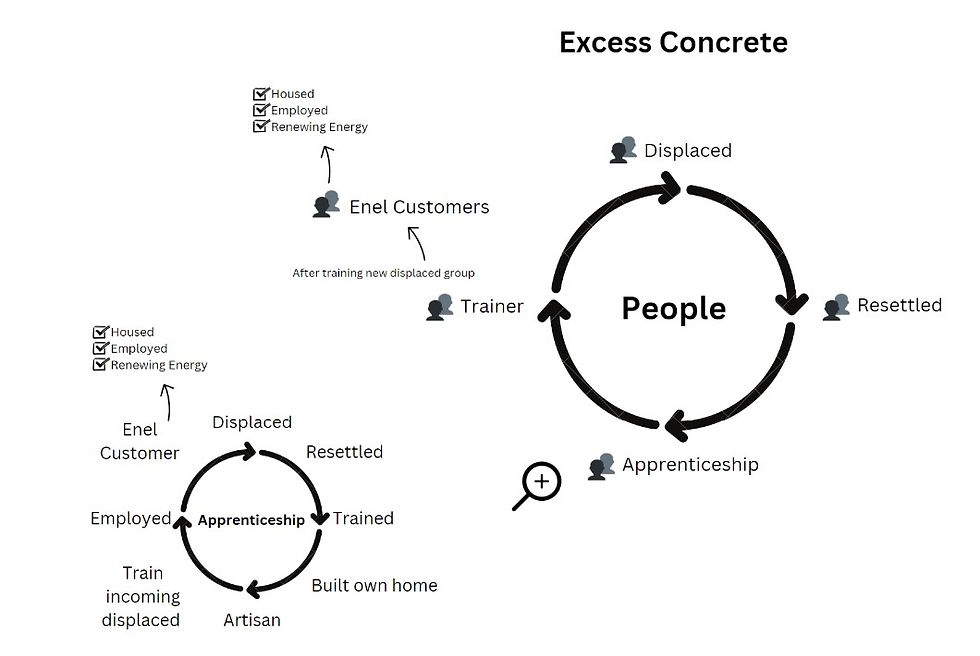
As group 1 finishes construction of their homes, group 2 arrives (same three population categories of displacement). Group 1 is now the trainer and group 2 goes through the same process as group 1 did - constructing additional structures for the community or finishing projects that group 1 started. Group 2 constructs their own homes separate from the rudimentary facility. Now that there are two sets of individual family homes, no more construction is necessary. If the government or contracted partner wants to send more individuals past the 200 capacity (2 groups of 100) then more structures can be made. The reason two sets of structures are adequate is because before group 3 arrives, group 1 has graduated and departed leaving their home structures vacant. These are filled by group 3 and once group 2 departs after training group 3, they now leave space for group 4. The cycle continues (shown in the diagram below).
The next phase is graduation and departure. The individuals have been trained in their respective fields, they have put that learning to hands-on application and created their products. After that they became the trainers themselves to demonstrate true understanding of the concepts. They have attended resume and interview workshops and even met companies that have attended the career fairs. They have secured offers and locations at these career fairs and are ready to leave the settlement. They enter long term contracts for sustainable energy PV renewable energy in their residence with Enel. Group 1 graduates and the cycle is repeated with all subsequent groups.
Figure 1. The Social Impact Circular Process of Excess Concrete
Journey of the Concrete
This proposal is intentionally simple in terms of the concrete involvement. The first stage is the collection. This will be done by the demolition team. The concrete will be transported to two potential places. The first would be a potential flood area for damage mitigation through the flood diversion tunnel. The second is the resettlement camps. Once the concrete arrives in the intended destination, it is taken care of from the description above. Part 2 and 3 of this proposal will introduce new potentials for concrete.
PART 2.
Part 2 continues the impact focus lens socially, economically and environmentally. There are a number of solutions in part two. One of which entails mixing concrete dust with compounds that make it biodegradable and using this biodegradable form to drop over forest fires as a fire retardant. The properties of concrete eliminate the oxygen suffocating the fire and the biodegradable compounds allow it to avoid damaging the soil. In a similar vein, concrete barriers can be laid down in locations recommended by local fire rangers to limit the fire spreading.
Highways run for hundreds and thousands of miles. The median is typically unused land with some form of concrete barrier already in place. There would be great benefit to completing those two barrier walls into complete walls for a train or a bike lane to be built. On top of this lane, solar panels are laid. Across thousands and thousands of miles of road, let’s capture solar energy instead of solely auto emissions. Carbon capturing greenery could be placed on the roofs as well in between solar panels to reduce carbon emissions intermittently between the renewable energy capture.
Shantytowns and villages around the world would benefit tremendously from the weather resistant properties of concrete. Instead of their mud huts and straw roof, concrete walls could be constructed and a diluted concrete roofing as well. Wall with a base of mud and outer lining of concrete would be a solution to fortify the strength of the structure and decrease the costs of the input, stretching the same amount of concrete much farther. These shantytowns can be further equipped with concrete wells to obtain potable water. The concrete can also be used to create a bio sand concrete water filter to remove particulate contaminants from the drinking water in the community.
PART 3.
Part 3 is the most modern possibility with the excess concrete. 3D printing is becoming more and more popular. This technology is able to print a wide variety of materials including concrete. Printing concrete provides the benefits and precision otherwise unavailable with the concrete laying process. The intricacies in buildings, art, facilities, functional objects is previously unmatched. This concrete can last over 100 years. From grounds of art museums to the new method of statues and construction, 3D printing can turn Enel’s excess concrete into high value items and revenue. Enel can develop 3D concrete printing technology or partner with a company to contract out further business opportunities with the replicable templates for upcycled concrete structures to be sold around the world. This captures the benefit of eliminating the need for additional concrete to be produced, saving CO2 and allows Enel a “free” input for these building contracts. Translucent concrete adds another element of value addition that serves higher end clients well.
This 3D printer can be loaded on a truck and taken along the highway to form the median solar concrete tunnel. This system can involve multiple trucks traveling the same direction spaced strategically laying down the concrete layer by layer. This same system can be used for road construction - anytime concrete needs to be laid down along the road, these mobile 3D printing machines can eliminate human danger on fast moving roads, remove human error and work 24/7 until the job is complete.
CONCLUSION
Concrete remains a significant detriment to earth’s climate. As mentioned, 4 billion tons are produced contributing to 8% of global carbon production. It also is taken to the landfill contributing to millions of kilograms of mass annually. This proposal offers 3 major solutions of tackling these issues by eliminating the need for concrete to be taken to landfills and reducing the overall need for concrete production in the first place by sourcing from reusable concrete after demolition. Part one is a circular holistic solution to housing, employing and teaching lifelong skills to displaced populations. Part two provides solutions for combatting forest fires, capturing solar energy from hundreds of thousands of miles of highways while allowing further transportation on that land and creating safer, more resilient shantytowns with potable drinking water. Part three highlights modern applications of 3D printing transforming the concrete into a plethora of potential beneficial structures. There are nearly limitless end uses for upcycled concrete. This solution provides three highly logical and strategic world altering options that help combat climate change, transform lives and provide significant economic return to Enel.


Comments