Spinning Energy Capture on Its Head: Two-Way Mirrored APV Ferris Wheel
- jacobfosss
- Aug 9, 2023
- 8 min read


Spinning Energy Capture on Its Head: Two-Way Mirrored APV Ferris Wheel
Abstract
The problem with sustainable energy solutions is not the lack of natural resources the world provides us every day, it is the methods of harnessing those resources into energy effectively.
Current agrophotovoltaic (APV) solutions take up too much land and cause too much shade for crops to grow optimally. These attempts have been aimed at minimizing yield losses while installing APV solutions instead of maximizing gains with the added technology. This is backwards and there is a solution that flips the script by increasing yields, increasing solar energy capture and eliminates the need for increased land usage. This solution does so through natural principles of photosynthesis and existing modern technology applied with a twist.
Crops have optimal periods of light exposure. Natural sunshine averages out to approximately meet those needs, but there is rarely a perfect match between a plant’s photosynthetic needs and the actual sunlight absorbed that day – this solution changes that. It does so through the utilization of existing principles applied in a new combination of technology.
The solution is a Ferris wheel-size rotating pinwheel incorporating photovoltaic (PV) cells and two-way mirror slits. The PV cells convert solar energy into electricity and the two-way mirrors allow selective amounts of sunlight to reach the crops on a daily basis while reflecting light across the field to their adjacent Ferris wheel structures. This provides a custom-catered photosynthetic-inspired approach to crops daily solar needs while simultaneously enhancing the total solar energy captured through reflection and refraction. There are irrigation and fertilizer applications installed to further meet the holistic need of the crops in this agrophotovoltaic solution.
Proposal
Italy has 16.7 million hectares of agricultural land. This is ~17 million hectares of agrophotovoltaic (APV) energy potential. Captured correctly, this allows Italy to play a significant role in helping achieve the global goal of net zero emissions by 2050 through sustainable energy capture. This proposal achieves that through simple translations of existing technology and concepts applied in novel, yet feasible methods. These properties include two-way mirrors for light dispersion, vertically standing APV’s to minimize land usage (compared to the current horizontal panels preventing sunlight to reach the field beneath it), crop-specific light passage controlled by rotating Ferris wheel technology, custom-released irrigation and fertilizer applications to eliminate modern day sprinkler and tractor emissions and double-sided PV panel walls with additional mirror systems in between to multiply the natural energy capture further.

The crops in focus for this proposal are the most popular Italian crops in the market of 2022 and forecasted for the next 30 years. These include corn, tomatoes, wheat, rice, olives, grapes, potatoes, citrus fruits, as well as legumes and tubers. The beauty of this technology is the custom-controlled irrigation, custom-controlled release of agricultural chemicals, as well as custom-controlled sun exposure to each crop.
Each crop has its own recommended sunlight exposure for optimal harvest yield as well as its own optimal fertilizer nutritional breakdown and volume application. Each crop has its own recommended pesticide, herbicide and other chemical or natural applicants. All of these crop specific requirements are addressed through the unique customizable nature of this structure.
The structure matches each crop with its optimal sunlight exposure every single day of the year. It does this through a rotational velocity-controlled pinwheel (simply put, the speed in which the Ferris wheel rotates). Each pinwheel has alternative circular sectors (imagine an enlarged dartboard and the pie slices of the alternating red and black color) alternating between photovoltaic panels and two-way mirrors. The PV captures the light directly, and the two-way mirrors both bounce off light to the field on one side and pass light through to the field on its other. This allows for selective light passage controlled by preset settings on each pinwheel based on crop requirement. For example, corn and tomatoes needs six to eight hours of sunlight (each crop species has its own requirement and can be taken into consideration for exact settings) and an open field in Italy’s peak agricultural season reaches 10+ hours of sunlight daily - this extra sun exposure limits the growth potential of these crops requiring as low as six hours per day. Reducing this exposure to the optimal levels is a benefit of this structure that not only enhances growth potential for the crops, but captures photovoltaic electricity creating a net energy positive solution to agriculture. Crops’ sunlight exposure also changes throughout their maturation stage until harvest. This technology allows for full adaptation to these sunlight requirements throughout the entire crop’s rotation.

There is an option for a drip irrigation line to be installed from each structure and a sprinkler system (again, catered to the crop and its hydration needs). This watering can take place at the specific time of day needed by the crop (typically at night to avoid burning of the crops by magnification of sun hitting the water molecules on the corn leaf, for instance). These irrigation techniques are adaptable to any source of water - wells, boreholes, reservoirs, water tank or hose system.
There is a similarly functioning fertilizer applier attached to the base of each structure. This attaches through a similarly engineered hose structure pulling the fertilizer from nearby sources. This fertilizer applier can also be used for pesticides, herbicides and other field applicants to suit the crops’ needs. This replaces the need for tractors to apply the same treatments, eliminating the harmful emissions tractors release into our atmosphere, further aiding this carbon neutral goal of Italian agriculture.
Weather protection is an inherent benefit of such a high-standing vertical structure. These structures offer a buffer from high winds, hail, heavy rains and powerful weather conditions that can damage crops and decimate yields.
All of these benefits are self-sustainable through the energy capture of the system. The energy requirements of the system’s features are only a fraction of the energy captured.
The Details
The pinwheel structure is seven meters in diameter. There are two symmetrical walls of panels. Each wall is spaced 0.75m apart and consists of two sides of PV’s - outward facing and inner facing.
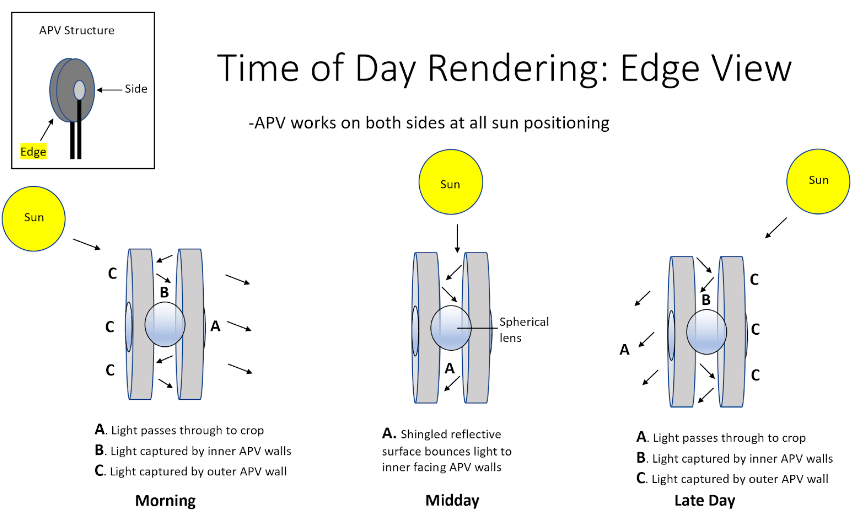
The outward-facing wall is flush vertical and alternates with the two- way mirror slits allowing light to pass through while simultaneously reflecting light back out to the adjacent field and the parallel PV Ferris wheel structure 21 meters away. The inner facing wall has staggered “shingles” of two- way mirrors angled at 22 degrees to reflect the light entering from the 0.7m clear lens at the top of the structure at high sun hours and the spherical lens in the middle. The center two-way spherical mirror is 1 meter in diameter and consists of concave lenses refracting the light into the inner channels of the structure. This light is bounced by staggered mirrors sitting at 22 degrees to reflect the light into the inner facing wall of PV’s.
There are six PV segments on each wall of the structure, 24 in total (6 units x 4 sides) and there are six two-way mirrors per side, 24 in total (6 units x 4 sides). The length of each PV panel and slit is the same at 3 meters. The degree arc of the PV panel is 45 degrees, and the degree arc of the two-way mirror is 15 degrees.
As we track the sun, the low-hanging eastern sunlight casts a shadow on the western side of the structures in the early and late hours of the day. That shadow reduces in length gradually until the mid hours of the day at which point, it becomes essentially non-existent during direct overhead sunlight hours. These hours are taken into account with the optimal sunlight exposure of the crops. The two-way mirror lenses complement these total hours of sunlight with their calculated additional hours to equal the crop’s optimal daily exposure to sunlight (approximately six to eight hours for most crops).
There are six drip irrigation lines on either side of the structure (12 total per structure) that fall 10.5m in length (half of the distance between the opposing structure running parallel). The rotor sprinkler heads total two per side (four total) and cover a range of 12 meters. The field applicators for fertilizers and chemicals cover a range of 14 meters with seven per side to have the ability to customize the distance between the applicants.
These structures can be placed side-by-side running the length of the agricultural field. A seven meter diameter allows for ~14 per hectare lengthwise and 21 meters apart allows for ~4 width-wise for a total of 64 per hectare. Over the span of a 1000 hectare field, that becomes 6674 units per 1000 hectares.
Energy
Based on a 17% PV cell efficiency on the outside panels, each square meter of outward PV generates 170 watts/hr. Based on a 10% PV cell efficiency on the inside, each square meter of inward PV generates 100 watts/hr. Each side of the structure consists of 9.4225 square meters (18.845 on the outside total and 18.845 total on the inside) for a total of 5088.15 watts/hr (45.8 kilowatts/ day in Italy’s farming seasons, given its average of 9 hours of daily sunlight).
Each hectare consists of 64 units, totalling 2,931 kw/day per hectare. That is the equivalent of powering ~147 houses which require approximately 20 kw per day. Taking the 13 million hectares of farmed land in Italy, that results in >38 billion kwh of energy. Given that this is a theoretical application, these yields could very well be significantly higher than 17 and 10%. This would drastically increase the amount of energy harvested.
Environmental Customization
One of the key components of this innovation is its vertical nature – minimizing land usage while maximizing solar capture. The reflective mirrors (both on the outer walls of the Ferris wheel and the inner) provide this switch between old horizontal practices to new vertical ones. This principle lends itself for non-agricultural settings as well. The engineering of this structure can be catered towards the environment in question. This is done through spacing of the structures and feature selection. If it is a non-agricultural environment, the rotation does not need to be included and the irrigation and fertilizer features can be removed. If there is not a need for agricultural vehicles to pass through the field, the spacing can be much closer. This would allow for increased solar energy capture on unused land and urban settings. Far greater surface area can fit in the same plot of land given this solution compared to current horizontal solar panels that populate our fields today and leave valuable real estate unoptimized.
Conclusion
The future of sustainable agriculture must turn towards a carbon negative approach to reach the global net zero emissions goal by 2050. This agrophotovoltaic proposal contributes to that goal by harvesting increased amounts of solar energy and higher yields of crops while minimizing the required amount of land to do so. This is accomplished through an energy self-sustaining vertically standing Ferris wheel-like structure comprised of four walls of agrophotovoltaic panels. The key components include:
Custom-catered sunlight exposure to each crop on a daily basis to maximize natural photosynthetic growth
Nutritional application to the soil custom-catered for each crop (fertilizer, natural and chemical pesticides, herbicides and more)
Irrigation with fully controlled water release based on time of day and by volume catered towards each crop’s daily need and weather protection
Vertically standing PV panels to increase the amount of PV cells per unit of land
This system would change the current agricultural landscape to one that requires less land, harvests more clean energy and provides more food leading to a self-sustainable and greener future.


Comments