Construction Reimagined: Carbon Neutral, Injury Free and Cost Saving


The Cube: The Future of Sustainable Construction
Abstract
Construction has a variety of negative effects on the environment, worker health and finances of the construction companies themselves. This is due to environmental pollutants (particulate matter (PM), volatile organic compounds (VOC), CO2 and other gaseous emissions); noise pollution; improper use, storage and disposal of materials; water waste; soil and ecosystem damage due to use and excavation; and worker injury and fatality. The aforementioned challenges have given rise to the development of sustainable construction sites. These sites are aimed at fixing and improving these detrimental effects of construction through good practices that minimize negative impacts to the environment, workers and local communities. This proposal taps into a variety of innovations that range from technological advancements to behavioral change. The result is a self-sustainable, zero-emission mobile construction site. This site is outfitted with an air quality analyzer ventilation feedback loop, noise cancellation vents and greenery that transform carbon to oxygen, and makes for a more enjoyable environment for the surrounding community. The system provides higher quality working conditions that will save construction companies money, while also alleviating work related injuries and casualties. This is all encapsulated in a protective photovoltaic solar energy barrier, ensuring the safest construction working conditions, highest air quality and most sustainable construction site in the world.
Mobile Photovoltaic Structure: The Cube
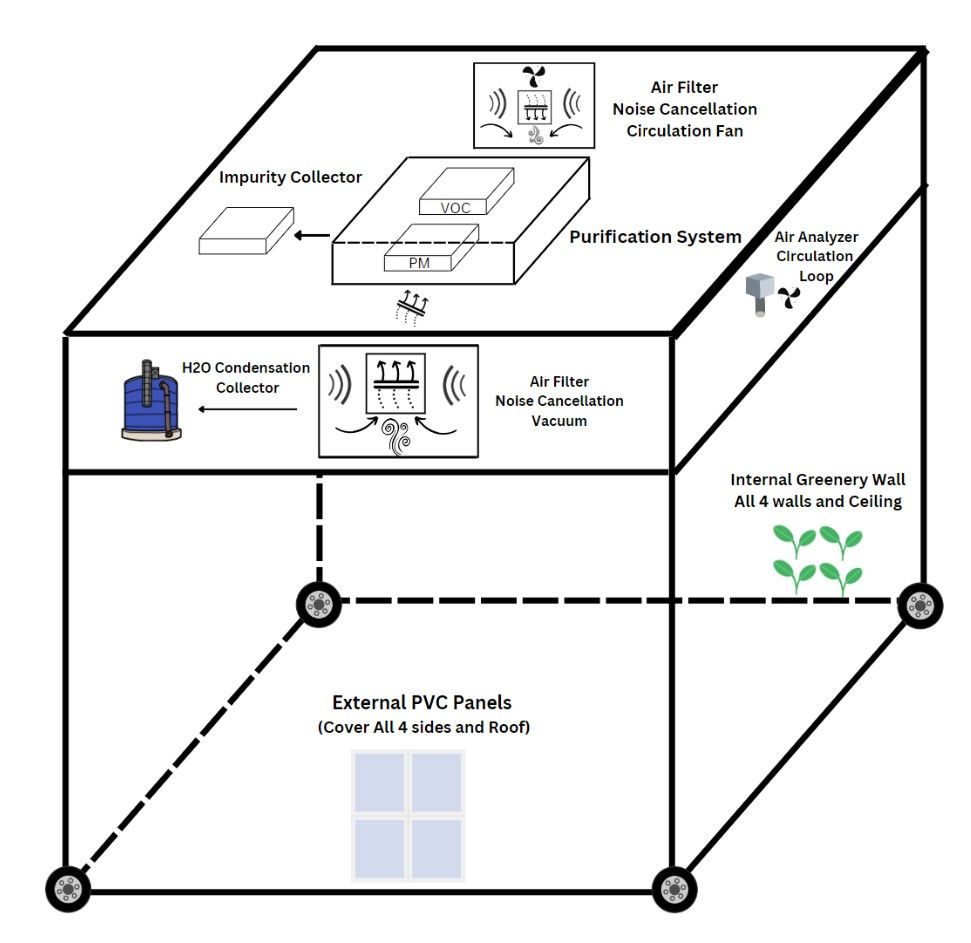
The structural foundation of this solution is a mobile photovoltaic structure that acts as a shelter from elements, a receptacle for recycling pollutants and a noise cancellation feature for surrounding communities. This structure can be pieced together and taken apart for efficient setup, packing and transportation and has wheels for portability once it is put together on the construction site. These wheels are on a hinge that allows them to flip down when transportation is necessary and flip up when the location is fixed, resecuring the air seal with the ground to prevent noise and air pollution from escaping by means other than the proper channels – noise canceling air filtration vents discussed below. The Cube’s external walls are lined with photovoltaic (PV) cells, which includes all sides of the structure, in addition to the roof. This serves as the renewable energy source powering the structure. This system will work perfectly during sunny weather; however, what happens when the sun is blocked (clouds, storms, nighttime)? This PV system will be attached to hydrogen fuel cells (HFC) to efficiently store and transport this energy because during days full of sunshine, the incoming electricity captured will outweigh the output needed to power the structure. This storage allows continual usage for all weather conditions. Hydrogen fuel cells are efficient (over twice the efficiency of traditional combustion technologies), green batteries due to their clean carbon-free outputs of only heat and water. This water can be collected and used to maintain and care for the greenery wall. The absence of toxic materials has an additional cost savings benefit eliminating the need for disposal and handling. Further cost savings are gained from the reusability of HFC’s by not requiring purchase, change and labor of battery replacements.
The internal sides of the Cube are lined with noise absorbing plant matter. Imagine the sprouts you see at a coffee shop for nutrition boosting shots. The structural makeup of the tightly packed shoots of greens are exactly what will line this wall. The high-density leaf layers allow dissipation and absorption of the sound waves originating from the construction. They also provide the first layer of carbon emission absorption due to their photosynthetic properties (taking in CO2 and emitting O2). This also brings in a new pleasant aesthetic with added health benefits. Greenery improves physiological and psychological health, reducing stress and improving worker morale. The second layer of environmental pollutant mitigation takes place in the noise and pollutant vents. The workers cannot safely remain in an enclosed environment with toxins saturating the air. These vents alleviate that issue by acting as the lungs of the structure - they bring in the toxic air (CO2, VOC, PM), filter them out and flush fresh, oxygenated air back into the structure. The mechanisms for upcycling each of the pollutants – gasses (i.e., CO2), VOC, and PM – will be discussed further below. The vents are powered by the solar panels and have separate vents to pump fresh air back into the structure through noise-canceling pores. The noise-canceling pores are effectively simple. We know the types of machinery that will be running in each construction site; therefore, we will know the decibel levels, wavelengths and frequencies emitted by each. We can use that to tap into the same noise-canceling technologies in headphones on an industrial scale. It involves wave frequency matching to perfectly cancel out and dissipate the construction sound waves. This allows the fresh air to enter through the vents while canceling the volume outputs within the facility.
Figure 1.
Working Conditions and Workers’ Health
The physical barrier is not just a foundation for other innovative features, it is a crucial innovation in itself. According to OSHA, 976 construction workers died in 2020, and according to the United States Bureau of Labor Statistics, 150,000 injuries to construction workers occurred in the same year. This is due to a number of causes including machine usage, falling debris and auto accidents due to exposure to the open roads and falling materials from above. The physical barrier of the cube will eliminate these issues and save countless lives. It will also reduce injuries, which is crucial to retaining and maintaining a healthy workforce and it doubles as a cost saver for companies paying the workers medical bills and sick pay. Another challenge that construction companies face is weather, as it is detrimental to workers morale, health and the efficiency of construction projects. Construction workers are sometimes forced to endure environments that fall outside of the fair working condition rules and regulations of OSHA. These regulations and best practices are commonly bent while managers look the other way to meet timelines. This solution structure alleviates that need, ensures construction workers have fair working conditions and helps projects stay on track. It further ensures deadlines are met by canceling most hindrances due to weather. Torrential downpours, sleet, hail, extreme heat and a number of other uncontrollable environmental factors can delay projects and cause missed deadlines. That is no longer an issue with on-the-ground work being sheltered by this sustainable structure. In summary, it protects workers, saves lives, saves employer costs, helps meet timelines and improves morale of workers through controllable, consistent, and satisfactory working environments.
Economic Impact
According to the Workplace Safety and Insurance Board, the average cost to construction companies for one lost-time injury on a job site is $35,000. The long term ramifications can be significantly higher due to litigation, rising medical expenses and compensation and long-term insurance price hikes. Construction Injury related costs makes up 6-9% of total project costs. By implementing the Cube, the physical protective barrier alone could reduce construction project costs by whole percentage points. It has been found that companies investing in as little as 2.5% of total project costs for safety procedures and training reduce accident rates and increase profits by 4-7% per project. A survey by NSC shows that every dollar invested in prevention saves $2 in accident costs. Every death prevented saves $1.39 million for the construction company1. Investments in safety go a long way. This proposal provides a physical structure that will provide significant injury cost savings and return on investment (ROI) as well as incentivized behavioral training modules for best safety practices in the construction workforce.
Construction’s Environmental Effect
According to Bimhow, the construction sector contributes to 23% of air pollution, 50% of the climatic change, 40% of drinking water pollution, and 50% of landfill wastes globally. The UK construction industry alone contributes to 25 million tonnes of landfill waste every year. This proposal explores numerous methods to reduce these negative effects, some of which will even transform a former pollutant into a beneficial byproduct. One of the main detriments is air pollution. In 2016, air pollution was responsible for an estimated 4.2 million premature deaths around the world2. It warms the planet, contributes to climate change and leads to a worrisome future with a growing amount of casualties. Construction elements that contribute to elevated levels of air pollution include machinery, vehicles and plants on site. Land clearing and demolition are significant contributors damaging the soil and releasing its stored carbon into the atmosphere. Demolition also causes high levels of dust to circulate into the atmosphere. Additionally, construction employs hazardous chemicals such as paints, plastics, glues and oils that leak into soil and water streams, and circulate into our atmosphere.
Particulate Matter
Particulate matter (PM) are small pieces of solids or liquids in the air – these can include dust, dirt, smoke, soot and liquid droplets. There are multiple types of PM and they are categorized by their size. PM10 has a diameter of less than ten micrometers and includes concrete, cement and wood dust as well as diesel engine exhaust of construction plants and vehicles. PM2.5 are finer dust particulate matter and particles found in burning fuel and exhaust. These contain a deep health hazard element as their small size allows them to penetrate the blood stream and deep into the lungs. Construction sites contribute 8% of PM10 and 14.5% of PM2.5 emissions globally. Most of this comes from machinery, diesel generators and 1% comes from dust. This proposal essentially eliminates all of those pollutants. Solar power replaces diesel and powers the machines. The exhaust and dust is captured and filtered by the air filters in the exhaust vents within the cube.
In addition to being harmful for the environment, construction workers pay a high health price by proximity. PM contributes to cancer, wheezing, lung issues, strokes, cardiovascular and respiratory diseases and worsening of asthma. Over half (56%) of occupational cancers in men occur in the construction industry. Workers are exposed to approximately 15 - 20 carcinogens in the common construction site2. Fair working conditions for a healthy workforce are incredibly important and far too often overlooked. This proposal remedies this and allows a dangerous field to become far safer through simple innovation and technology.
The roof will contain a centralized High-efficiency particulate arresting (HEPA) air filter. These have a removal rate of at least 99.97% of particulate matter 0.3 micrometer diameter and above. These HEPA filters will be washable and reusable, and during the sanitization process, PM will be drained from the filters and stored for recycling purposes. There are laboratories that can use the elements in PM for functions such as chemical reactions and polyethylene materials, which will prevent the PM from entering the local sewage systems, the soil and the atmosphere. There are countless end uses for this collected particulate matter. There is a Dutch artist transforming PM into gemstone jewelry with each ring representing 10,000 cubic meters of air purified. There are scientists transforming carbon and PM into inputs for printer ink. After the carcinogens and impurities are removed, the black powdery substance is what can be used for printer ink after mixing with alcohol and oil. We can transform the carbon polluting our air into beautiful T-shirt graphics, newspapers and magazines.
Volatile Organic Compounds (VOC’s)
Volatile organic compounds (VOC’s) are characterized by having high vapor pressure and low water solubility. Examples include paints and aerosols, wood preservatives, disinfectants and more. These are commonly found in construction sites and have a damaging effect on the environment and the health of workers. OSHA determined acceptable VOC permissible exposure level (PEL) is 0.75 ppm and an action level of 0.5ppm. In new buildings and construction materials, VOC emissions can reach as high as 20x the OSHA recommended levels3. According to the EPA, the average level of VOCs in homes is 5-10x the level of outdoor air and in construction sites that level is elevated even further.
How do we address this? Ventilation is one of the most important methods in reducing VOCS in the air. The stress on proper filtration vents and air circulation in this proposal addresses these levels and can reduce VOCs by as much as 80%.
VOC analyzers will be programmed to circulation vents and they will work like a thermostat feedback loop. If the VOC levels reach 0.5ppm, the vents will be switched on until the levels return back below the threshold deemed safe by OSHA. This will be powered by the cube’s solar panels. These air analyzers will also include measurements of PM, CO2, sulfur, hydrocarbons and other harmful gasses to kickstart the same cleansing feedback loop to create the cleanest construction air quality in the world.
Patented technology exists to break down VOC’s in plastics, paints and other materials through the use of chemicals and enzymes released by microorganisms. These chemicals break down the VOCs, altering their compound into a more environmentally neutral form or even a usable form, i.e., recycled plastics. The enzymes feed off of the plastics polyethylene (PET) to digest them without contributing to greenhouse gas emissions. These same processes can be applied to airborne VOCs in construction sites. As the pollutants are vacuumed through the roof vents, there will be a purification chamber with these chemicals and enzymes that will break down VOCs into usable forms free of environmental harm. The byproducts will be plastic inputs for use by recycling plastic companies or even an onsite 3D printer to create construction materials or repair machine parts instead of needing to wait weeks for custom part order delivery.
Catalytic ozonation is another method that will be used. Advanced oxidation is used to reduce the concentration of airborne pollutants. These results of VOC elimination were more effective than simple ozonation and adsorption. For example, advanced oxidation can reduce benzene, toluene, ethylbenzene and xylene (BTEX) to standard levels from their harmful toxic amounts prior to catalytic ozonation. BTEX sources include engine exhaust, gas emissions, crude oil, natural gas and petroleum. Specifically, benzene and toluene are present in petrol and occur from burning a variety of fuels from coal to wood, commonly found in unleaded fuel. Ethylbenzene is used for plastics, inks, dyes and petrol. Xylene is refined from crude oil and used in a variety of plastics, clothing, thinning paints and varnishes. Eliminating these is another crucial step that will be in the VOC purification chamber in tandem with the enzymatic and chemical breakdown.
Figure 2. Shows commonly found VOC’s. Exposure time is directly correlated to the damage done to the ozone, environment and our lungs. The Cube’s ventilation system (simply vacuum and fan set up) reduces this exposure time to essentially zero as the VOC’s, PM and gasses rise to the ventilation vacuum and are sent through the purification system instantaneously4. Reducing these exposure times to essentially zero renders their detrimental human and environmental effects to negligible amounts.
Figure 2.

3D Printer
A 3D printer can be connected to the hydrogen fuel cell to power recycling of excavated construction materials. Cement from roads can be broken down, mixed and placed in the 3D printer for precise laying of foundations, walls, highway medians and more. The same can be done with plastic waste and VOC byproducts to be used to make plastics. This opens the door to on-demand material and equipment ordering.
Water
Billions of gallons of water go to waste every year due to construction processes and inefficient water handling. Improper handling and water vapor are two forms in which this water goes to waste. Improper handling is addressed through water credits and learning modules - discussed further below. Construction processes create a lot of heat and vapor, which will rise and be collected through filtration vents that capture water from condensation. The vents will cool the vapor and reduce it back to its liquid state. Finally, this water will be captured in a reservoir that is attached to a hose that is readily available due to gravitational pressure due to its elevated origin of the cube roof. This reservoir will also be attached to elementary drip irrigation tubes to keep the internal sprout greenery wall alive that is responsible for absorption of noise and air pollutants. This will be a continual drip to ensure the weight of the roof remains minimal.
Part of the water problem is tapping into a seemingly abundant resource and because water is so readily available on taps across America, the excessive waste builds. One of the solutions to this problem is simply incentivizing human behavioral change. This will be done by assigning water credits to the construction company. This will award monetary resources in return for reduced water usage. The inputs of water will be recorded and there will be monetary awards in form of tax write offs and water credits assigned to tiers of water consumption. This will make construction project teams aware of the water they are consuming and place a focus on its limitation.
Another behavioral improvement technique that will be part of this proposal is incentivized learning modules. Poor construction behavior can lead to excess water consumption (described above), chemical dumping, improper handling, storage and use of materials and machinery and more. There will be a short course that covers each of these thoroughly in a sustainable manner highlighting the environmental benefits and the working condition benefits. Upon completion, each worker will receive a bonus to their paycheck. This bonus will be aimed at saving the construction company money by limiting inputs and aiding to further environmental health.
Construction Materials
Construction materials are a large contributor to landfill. 4 billion tons of concrete alone is produced every year and concrete leads to 8% of global CO2 production. Common waste products after demolition are asphalt, concrete, wood and metal. These all can be repurposed instead of dumped in a landfill. Repurposing needs to be a big post-life-cycle focus of these resources. Transportation of these materials is a contributor to air pollution as well with the burning of fossil fuel and diesel powering these vehicles. This can be reduced to an extent with the application of the cube to the bed of trucks. These cubes can be applied on fixed structures like machines and trucks as well as stand-alone shelters. The Cube walls will latch onto the walls of the open truck bed after filling with construction materials, and it can help power the vehicle. Hybrid electric vehicles can tap into the energy sourced from solar electricity captured by the mobile solar panels traveling along roads. Their ventilation systems can prevent further particulate matter and VOC’s escaping into the atmosphere with all of the shaking in the bed of the truck.
Unused construction materials are also an issue. The causes of this include over ordering, improper sizing and storage techniques. Far too many materials go to waste simply because of improper storage. The weather damages them, causes rot and renders them useless; however, the Cube provides an immediate solution to this. It provides protection from all elements, resulting in dry, protected materials, reducing storage caused waste. Improper measuring and cutting of materials stems from human error. This can be exacerbated by difficult work environments, stressful conditions and overall low morale. With the comfort enhancing working conditions as a result of the Cube’s protection, these human errors are expected to lessen because the workers’ focus will be placed more on the task at hand and less on their safety and well-being. If the 3D printer is implemented, as discussed above, order projection errors become eliminated. Instead of projecting inventory needs months in advance and hoping your losses from error are minimal, the materials can be printed immediately, guaranteeing there are no losses from improper ordering.
Soil and Restoration of Excavations
Construction damages soil and the ecosystem around the work site in a number of ways. Chemical run off, root system damage and soil erosion. The chemical runoff is held in check in part by the gaseous collection of the Cube. This prevents chemicals in the air from entering the soil. Strength and renovation of the soil will be a communal effort. Local populations in areas of the construction site can bring in organic matter - woodchips, logs, sugarcane, corn husks, peanut shells etc. to be entered into a pyrolysis chamber. These individuals can range from farmers and gardeners to inmates, homeless individuals or anyone looking to make a dollar through positive environmental impact. The pyrolysis chamber will create compost to improve soil health of the area around the construction site. The individuals can either simply bring the organic matter or they can extend further and work on tending to the soil and returning what was excavated during construction. The rewards will be as follows: inmates can receive time off of their parole for community involvement, farmers and gardeners can receive nutritious compost for their fields and the homeless and other individuals looking to make money can get monetary rewards for their community building labor. The funding for these cash incentives will come from carbon credits from the carbon returned to the soil through organic recycling and the reduction of methane by eliminating a rotting organic matter from the atmosphere. If the construction site is longer and more permanent, a large gasification chamber can be installed to create an additional source of clean energy and include waste materials from the construction site.
Conclusion
This proposal provides safer working conditions in construction sites through a self-sustainable eco friendly mobile construction unit (the Cube). The Cube cancels noise pollution, filters out air pollution (greenhouse gasses, particulate matter and volatile organic compounds) to reduce carbon footprint, harvests and stores solar energy and improves likelihood of meeting project deadlines. It has the potential to save billions of dollars in construction injury and death prevention due to its protective physical barrier, weatherproofing structure and worker performance boosting features. The construction sector contributes to 23% of global air pollution and air pollution accounts for nearly 5 million premature deaths annually. The Cube has the innovative technology to reduce those numbers and lead to a cleaner environment with more lives saved. Its importance cannot be overlooked and its simple implementation can be utilized by construction sites everywhere for an on-the-go solution to construction’s problems.
Sources
1. CIB Working Commission W99: Safety and Health on Construction Sites., Dias, L. M. A., & Coble, R. J. (1996). Implementation of safety and health on construction sites. Rotterdam: A.A. Balkema.
2. Guzder, Kristin. “Construction Pollution: Types & Prevention Methods.” The Hub | High Speed Training, High Speed Training, 15 June 2022, https://www.highspeedtraining.co.uk/hub/pollution-from-construction/.
3. Lafond, Adrien, and Adrien Lafond. “Volatile Organic Compounds (Vocs) Exposure in Building Materials.” Foobot, 26 Sept. 2018, https://foobot.io/guides/volatile-organic-compounds-in-building-materials.php#:~:text=Total%20VOC%20Concentration%20in%20Buildings%20and%20Adverse%20Effects&text=In%20new%20buildings%20and%20new,0.5%20to%2019%20mg%2Fm3.
4. Ulker, Ozge Cemiloglu, et al. “Volatile Organic Compounds (Vocs) Emitted from Coated Furniture Units.” MDPI, Multidisciplinary Digital Publishing Institute, 2 July 2021, https://www.mdpi.com/2079-6412/11/7/806.


Comments